ARTICLE
Most innovation projects don't sell. And it's not for the reason you think.

Javier Gibert
Growth & Genesis Lead
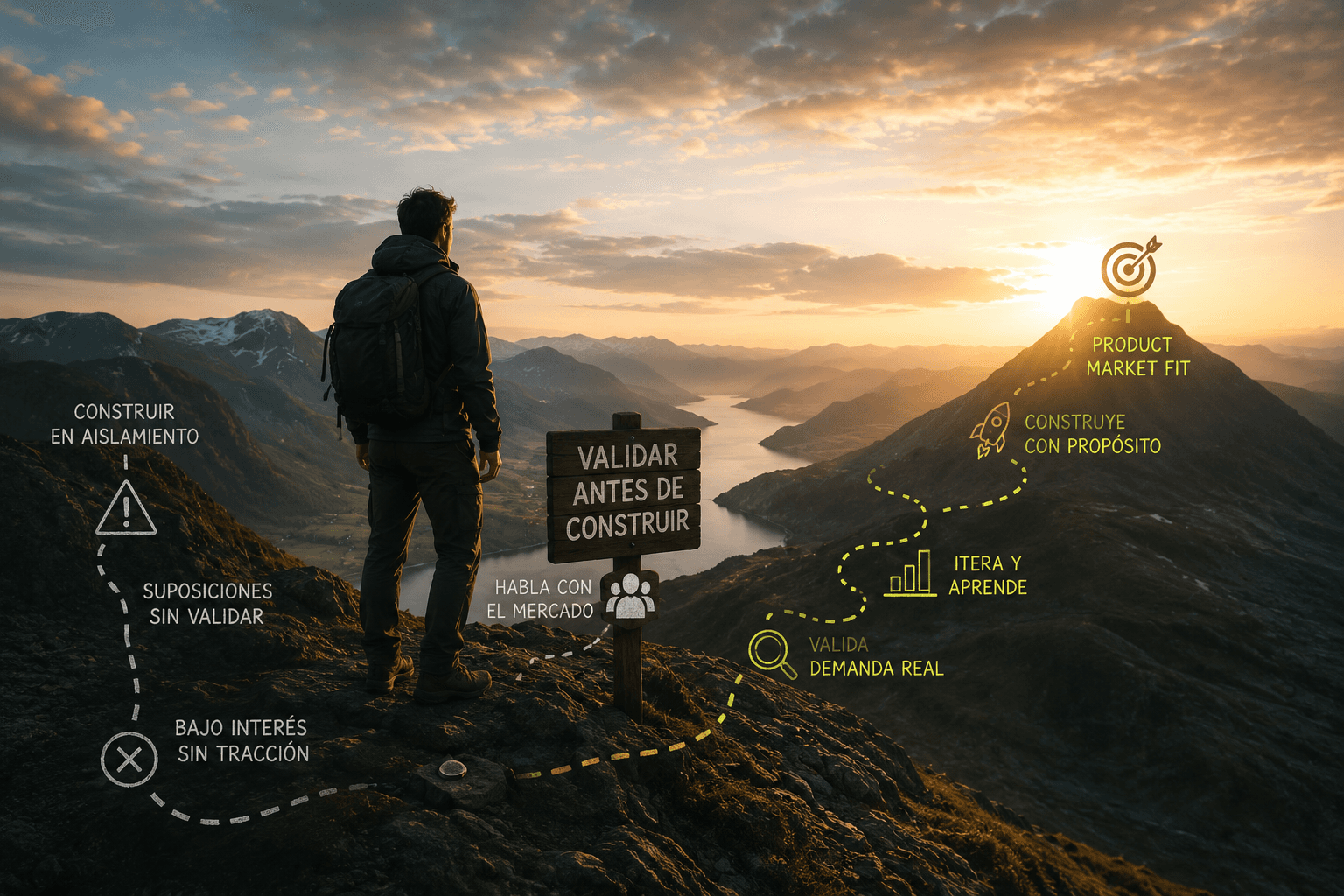
If you can't sell a simple version of your idea today, you will hardly be able to sell the full version tomorrow. What happens when growth and building work together from Day 1?
In innovation, the problem is not usually a lack of ideas. It is a lack of sales.
In corporations and venture building teams we constantly see initiatives that, on paper, have everything going for them: well-designed proposals, aligned with trends, backed by research and market insights. However, when they hit the market, they don't convert. They don't generate traction. They don't sell.
And many times this doesn't happen because of a lack of talent, technology, or execution. It happens because nobody really validated whether demand existed before they started building.
After years of launching new businesses, there is one conclusion that appears time and again: many initiatives fail not because the product is badly made, but because nobody designed how it was going to be sold from the very beginning.
A growth team would incorporate this from the start. But not as a replacement for building, but rather working alongside the product team to validate what is worth building and how to turn it into a real business.
“The only thing that matters is getting to product-market fit.” Marc Andreessen
The big mistake: building before selling
Most innovation projects still follow a rather traditional logic:
idea → development → launch → (silence)
For months, entire teams work on defining features, designing experiences, and building product. Everything seems to progress... until the moment comes to face the market. And that is where many initiatives break down.
Because selling is not an automatic consequence of building.
The disconnect is obvious: huge amounts of time are invested in defining what the product is, but very little in validating how it is going to generate real demand and how it is going to be sold.
The best projects are not born when product builds and growth comes in at the end. They are born when both teams work together from the beginning: understanding the user, validating demand, iterating positioning, and learning from the market in real time. Because building value and capturing it are part of the same process.
How teams that get traction think: selling is also part of the product
For the teams that manage to build sustainable businesses, the channel, the message, the positioning, and the conversion are not a later layer. They are part of the business design itself.
That's why, from Day 1, the questions are different:
Who would actually buy this?
What problem is it solving?
Where does that user or customer live?
What message makes them react?
How much does it cost to acquire them?
Is there real intent to pay, or just interest?
Because in many digital models there is an uncomfortable truth: if you can't sell a simplified version of your value proposition, you probably won't be able to sell the full version either. And that ability to generate early revenue is not just a commercial metric; it is a sign that there is a problem important enough for someone to want to pay to solve it.
That's why, instead of starting by building product in isolation, the most effective teams start by validating demand.
This does not mean that every decision must be optimized for the short term or that product is secondary. It means understanding that the market is part of the building process. And key decisions can be better made by the builder team when that conversation with real customers happens as early as possible.
There are categories where the market does not always know what it wants until it sees it. But even in those cases, validating early signals of demand reduces the risk of building in a vacuum.
The three mistakes that block sales
1. Confusing interest with purchasing intent
Many companies validate ideas through interviews, workshops, or internal surveys.
The problem is that declared interest rarely equals actual behavior.
Just because someone says "yes, I would use it" doesn't mean they are going to pay. Growth works with signals that are much harder to fake: clicks, sign-ups, sales inquiries, bookings, demos, or actual payments.
Because that is where the truth of the market begins.
2. Not validating acquisition channels
Many projects assume that "they will find a way to grow" once the product is ready. But channels are not discovered, they are tested.
If you don't know how much it costs to acquire a customer before building, you are designing a business blindly.
3. Designing without real friction
In controlled environments, everything seems to work. But the market introduces friction: distrust, saturation, alternatives, timing, or price.
A growth team introduces that friction from the beginning, because they know that is where everything is actually decided.
What would a growth team do from Day 1?
Instead of building a complete product, a growth team designs experiments to validate the sale. Not as a theoretical exercise, but as real market validation.
Turn the idea into a sellable proposition
Before developing, a concrete and testable value proposition is defined: a clear problem, a specific segment, a tangible benefit, and a direct call to action.
This translates into simple assets: landings, ads, messages, or manual demos.
Launch real acquisition tests
In days, not months, campaigns are activated on Meta, Google, or LinkedIn to answer key questions:
which message converts better,
which segment responds,
what the acquisition cost is,
and what level of intent actually exists.
This is where the first real insights appear.
Measure intent to pay, not just interest
The goal is not to generate traffic, but to validate real demand:
forms with intent to purchase,
pre-orders,
qualified waitlists,
or even first transactions.
If nobody takes the step, that signal is also valuable.
Iterate or kill quickly
Every experiment has a clear decision criterion: scale, iterate, or stop.
This avoids months of investment in ideas that do not work and allows resources to be concentrated where real signals do appear.
A simple, and frequent, example
Recently, a team was working on a new B2B solution to automate internal reporting. The initial plan included several months of development before launch.
Instead of building first, they decided to validate demand.
They created:
a simple landing page,
targeted campaigns on LinkedIn,
and a manual demo of the service without any developed product.
In less than two weeks they discovered something key: the problem was interesting, but the initial message was not converting. The original pitch talked about "automation." The market reacted much better to another idea: "saving operational hours for managers."
That change multiplied conversion and allowed them to validate commercial interest before investing in product.
The original idea wasn't bad. The initial positioning was.
From idea to business: true product-market fit
Product-market fit doesn't happen when the product is finished. It happens when the market responds. And that response usually appears in three signals: conversion, retention, and revenue.
The teams that work best do not wait to have the perfect product to validate this. They force it from the beginning. Because they understand that the greatest risk is not building badly, but building something that nobody wants to buy.
Three principles to avoid building something that doesn't sell
Start with demand, not product
If there is no clear way to acquire customers, there is probably no business yet.
Validate with real behavior, not just opinions
The metrics that matter involve action.
Minimize the time between idea and market
The sooner you face reality, the sooner you can make better decisions.
In an environment where every company wants to innovate, the difference is not in having more ideas, but in knowing which ones deserve to become a business.
Because an idea doesn't become a business when it generates internal enthusiasm.
It becomes a business when the market responds.
And that is where building and growth stop being separate functions to become a single learning system.