ARTICLE
What we learned building ventures from within

Albert Peralba
Senior Business Builder

After a few years of building ventures with corporations, one of the questions I am asked most is: "what is it that truly makes the difference between a venture that takes off and one that falls by the wayside?"
The honest answer is not a single thing. It is the sum of small decisions, almost always made during uncomfortable moments, which over time turn into patterns. Some we learned quickly. Others cost us several projects to fully understand.
At Byld, we have designed more than 250 venture concepts, validated more than 50, and today we have a dozen active in our portfolio. What is interesting is not that photograph, but what lies underneath: the accumulated learning from working hand in hand with corporations that bring something no startup has from day one (real clients, distribution channels, industry knowledge, capital, brand, technology,...)
This article is not a recipe. It is a handful of practical learnings, ordered by the phase of the process in which they appear, designed for anyone who is starting or rethinking a venture building initiative within their company.
The starting point: the corporation is not the problem, it is the asset
Before going into the phases, an idea that we think is important: the corporations we work with are not obstacles to avoid. They are the venture's main asset. When you launch something new from within a consolidated company, you start with advantages that a startup would take years to build: access to clients, real data, operational capacity, brand credibility, and, in many cases, patient capital.
The job of the venture builder is not to fight against that structure, but to design the project to leverage it without being suffocated by it. That is the tension we learned to manage best over time, and the one behind nearly all the learnings that follow.
Phase 1 — Insights: learning to ask better questions
The insights phase usually starts with a broad question: where could we grow?, what trend could we capture?, what opportunity are we leaving on the table?. The natural instinct is to look for answers. The learning that has served us most is exactly the opposite: before looking for answers, it is worth investing time in refining the question.
We say this because we have seen processes where teams delivered a very solid analysis... but answered a question that was no longer the important one. And that happens more frequently than it seems.
Some recommendations that have helped us:
Not all insights have to change the course of the project. Sometimes they simply confirm an intuition, and that is also valuable. The important thing is to know what type of insight each one is: if it opens a new path, if it closes a hypothesis, if it confirms a direction, or if it just adds context.
Distinguish what people say from what people do. Interviews are useful, but their value grows significantly when combined with behavioral data.
Close the phase with testable hypotheses, not with conclusions. A well-formulated hypothesis is worth more than twenty pages of analysis.
Phase 2 — Labs: validating to invest better, not to go faster
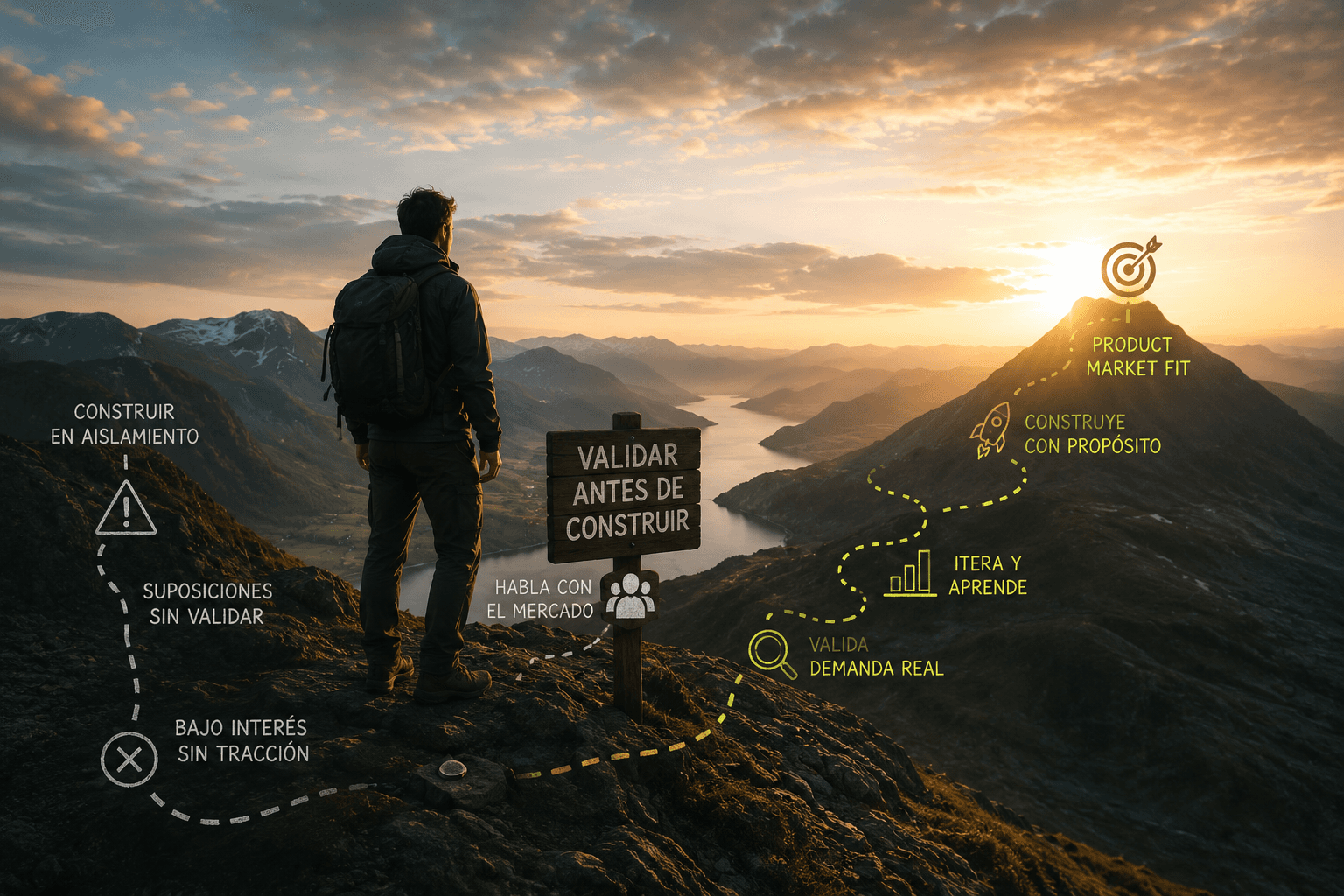
The labs phase is where validation loops, MVPs, business model validation and, at the close, a Building Plan cross paths. It is probably the most misunderstood phase of the process, and we understand why: when there is already an idea that looks good, the natural thing is to want to start building it as soon as possible, but performing it is key, because it allows you to reduce the venture's risk quickly and with the minimum resources possible.
What we have learned is that labs does not exist to save time, but to invest it better. Every hypothesis validated or discarded in this phase saves months of development in the next. And conversely: every unvalidated hypothesis you drag into the construction phase multiplies the cost tenfold.
Some things that have worked for us:
Prioritize hypotheses by risk, not by ease. The first thing to be validated should be that which, if it fails, makes the project unviable. It is usually the most uncomfortable thing to test, and that is why it is often left for last.
Look at behaviors, not just opinions. A real conversion, a first payment, a reservation with commitment, are worth more than ten intention surveys.
Close the phase with an honest Building Plan. This includes collecting what did not work. Negative learnings are just as useful as positive ones for making subsequent decisions.
Phase 3 — Ventures: the moment the project becomes a company
The Ventures phase is when everything becomes real: incorporation, team, product, first sales, governance. It is also the phase where most things can go right or run off course, because it is where the venture stops being an internal project to start behaving like a company.
A learning that has been key for us: the most important decision moments come a few months after the launch. Once the team is assembled and the first metrics start coming in, you have to decide frequently whether to accelerate, adjust, or change course. And those decisions are easier if they have been thought through before needing them.
Some recommendations that have helped us in this phase:
Define decision criteria before starting. What metric, at what moment, triggers what type of conversation. Not to automate the decision, but to have it well prepared when it arrives.
Take care of the relationship with the corporate sponsor. It is one of the most undervalued levers. An involved, informed sponsor with skin in the game makes the difference in difficult moments.
Think about the go-to-market from the beginning. The ventures that worked best were those that designed their commercial model with the corporation, leveraging its channels when it made sense and building their own channels when the fit was not natural. There is no single answer: it depends a lot on the product, the client, and the existing network.
What unites the three phases: light and well-designed governance
If I had to highlight a transversal learning, it would be this: in corporate venture building, governance is product. How decisions are made, who makes them, with what frequency, and with what information, influences the result as much as the quality of the idea.
Some principles that have worked well for us:
Small and well-prepared committees. Three people with the right information make better decisions than twelve trying to align themselves.
Short meetings with raw data. Presentations are useful for communicating externally; within the team, what helps is seeing the data directly.
Fast and reversible decisions. In the early phases, almost all decisions are. It is better to move forward and correct than to wait for absolute certainty.
What do we take away after all these projects?
Building ventures from within a corporation is an exercise in permanent translation: between the world of the market and the world of the company, between the speed of exploration and the rigor of execution, between the new and what already exists. That translation is never perfect, but when done well, the results are difficult to achieve in any other way.
The most important learnings we take away are not methodological, they are of judgment: when to listen to the market, when to trust internal knowledge, when to accelerate, and when to stop. And understanding that corporate innovation works best when thought of as a continuous learning process between two worlds that need each other.
If you are starting a new venture or rethinking one that is already underway, perhaps these three questions will help you get started:
Do we have clear hypotheses, prioritized by risk, before moving on to template building?
Have we designed how we fit with the corporation's assets, without depending entirely on them?
Do we know what metrics are going to tell us, in a few months, if we are on the right track or if we should adjust?
There are no unique answers, and each venture ends up finding its own balance. But asking these questions early, before inertia pushes, is usually one of the project's best investments of time.
If any of these reflections connect with something you are experiencing right now, we would be delighted to exchange views.