ARTICLE
Growth without ego: why most marketing strategies are born too big.

Eduardo Liviano
Building Manager

When a company decides to "get serious about growth", almost always the same thing happens: the plan is born huge. Many channels at once, a budget that must be justified, a big launch campaign, and an expectation of results that does not fit with how little is still known about the market. You invest before you learn. And when something doesn't work, it's hard to know what failed because too many pieces were moved at the same time.
The cause is rarely a lack of talent or resources (which is also true). It is ego. The need for the strategy to "look big" from day one outweighs the discipline of starting small. And that very human bias is probably what burns the most money in marketing.
After years of building new businesses (→ internal link: new business) from within corporations, we have seen the same pattern in growth as in venture building (→ internal link: venture building): the initiatives that take off are almost never those that were born most ambitious, but those that were born humbler and learned faster.
The problem is not ambition; it is the starting point.
Ambition and size are not the same. You can have huge ambition (building a brand, opening a market, multiplying acquisition) and still start with a deliberately small strategy. In fact, that is usually the only sensible way to achieve it.
Growth understood as a discipline is not about deploying the definitive strategy from minute one, but about discovering it. And to discover it, you have to turn off the ego: accept that at the beginning we do not know which channel, which message, or which audience will work. We will know later, and only if we design the process to find out cheaply.
Both from Byld at the validation level and other referents in the sector have been repeating it for years: sustained growth does not come from a great idea, but from a system of constant experimentation, well-chosen levers, and the humility to let data (not the boss's intuition) decide what scales.
1. Start with the question, not the plan.
Most large strategies start by answering before asking. The channel, budget, and schedule are decided, and only then is it checked if the market responds. It is the reverse order of what works.
Before investing, it is worth pausing in the insights phase (→ internal link: insights) and refining the right question: who exactly is the customer we want to acquire?, what problem do we solve better for them than the alternative?, where are they already, without us having to "create demand"?
Some things that have helped us:
Distinguish what people say from what people do. An intention survey is worth much less than a click, a registration, or a first payment.
Do not confuse awareness with growth. Many large campaigns generate measurable noise but not business; it is advisable to be clear from the start on which metric really matters.
Close this phase with testable hypotheses, not with a closed plan. A well-formulated hypothesis is more useful than a forty-page .ppt.
2. Small experiments before big campaigns.
This is where ego does the most damage. When there is already an idea that looks good, the natural thing is to want to launch it big. But every euro invested in scaling something unvalidated multiplies the cost of the error.
The logic of the laboratory (Labs) (→ internal link: labs) is the opposite: not spending to go faster, but experimenting to invest better. Every cheap test that discards a channel or a message saves an entire budget later on. The importance of "noes" in life; just like that.
What has worked for us:
Prioritize experiments by risk, not by ease. The first thing to test is whatever, if it fails, makes the entire strategy unfeasible (what we usually call the "no-go assumptions"). It is usually the most uncomfortable, and that is why it is often left for the end.
Keep the cost of error low. Small budgets, short deadlines, fast learning. Ten modest tests are better than a single bet.
Also record what does not work. A well-documented failed experiment guides subsequent decisions as much as a successful one.
3. Scale only what has proven to work.
The time to think big comes after, not before. When an experiment shows real and repeatable traction, then it makes sense to concentrate the budget, expand the channel, and build a big campaign. The difference is that now you scale on evidence, not on hope.
Some recommendations for this phase:
Define beforehand what signal triggers the investment. Which metric, at what threshold, justifies moving from experiment to bet.
Scale one by one. Bringing in multiple levers at the same time makes it impossible to know what is working.
Take care of the relationship with whoever approves the budget (even if internal). An informed sponsor, who understands that you learn first and invest later, is one of the most undervalued levers of growth.
What unites the three phases: operational humility
If we had to stick to just one idea, it would be this: in growth, humility is a competitive advantage. Not humility as a pose, but as a method (small and reversible decisions, willingness to be wrong, and letting the data rule).
Strategies that are born too big do so because they confuse confidence with certainty. And in the early stages, almost nothing is certain. Moving fast, measuring, and correcting almost always beats waiting for the perfect strategy.
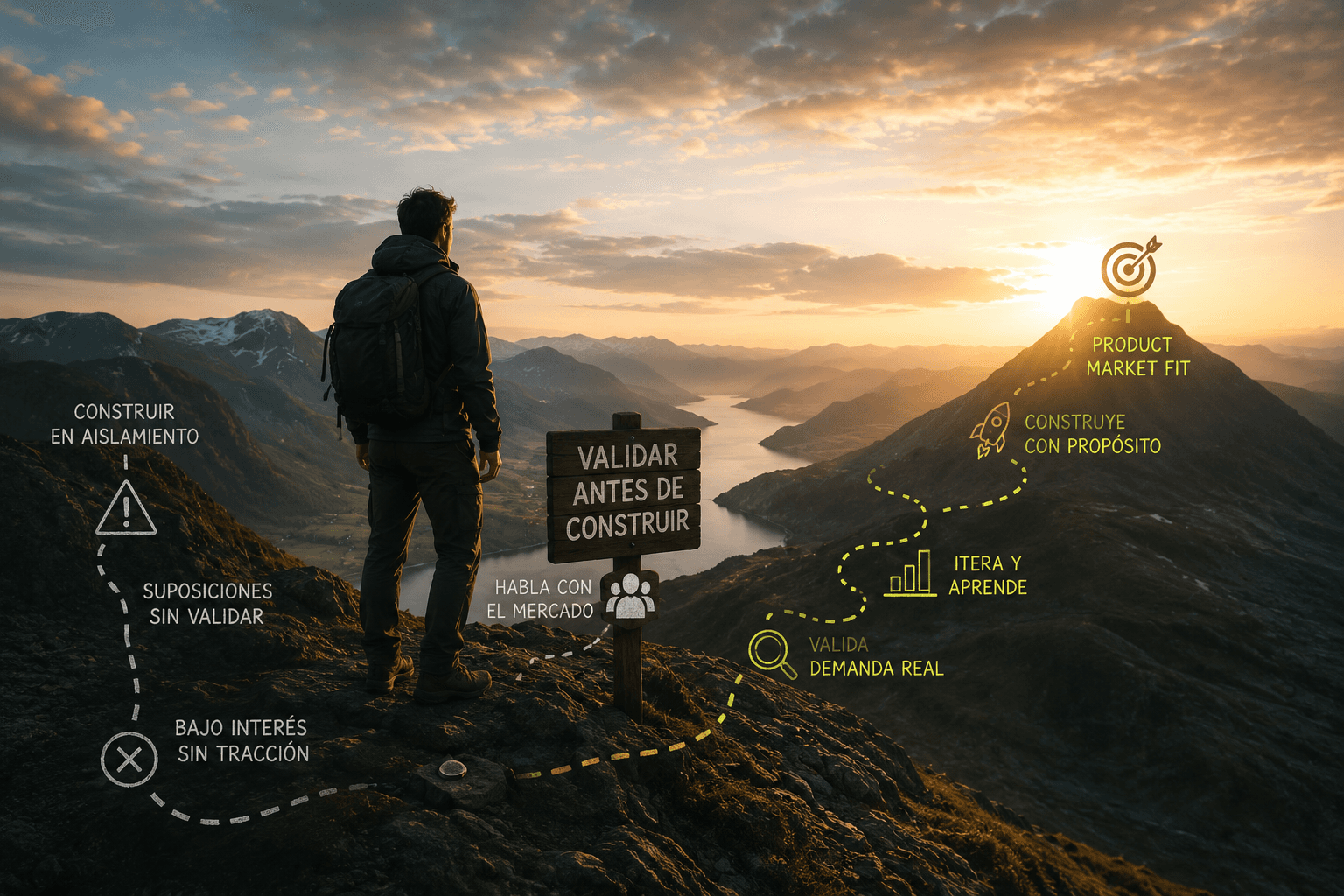
It is exactly the same discipline we apply when building ventures: validate cheaply and quickly, prioritize by risk, and scale only what has already proven to work.
What we take away.
Good growth is less like a big launch and more like a continuous learning process. It doesn't start with the answer; it starts with the best question and the most affordable experiment to answer it.
If you are defining or rethinking your marketing strategy, perhaps these three questions will help you get started:
Does our strategy stem from a hypothesis we can test cheaply, or from a plan that already assumes the answer?
Do we know what specific signal will tell us if something works before we scale it?
Are we willing to kill what doesn't work, even if it was our idea?
There is no single recipe, and each team ends up finding its own balance. That said, asking these questions early (before inertia and ego push toward the big) is usually the best investment of the entire strategy.
If any of this connects with what you are experiencing right now, we would be delighted to exchange views.